Temperature-controlled transport: challenges and isothermal solutions

CONTENTS
1. What is temperature-controlled transport
What types of products should be protected?
ATP regulations for temperature-controlled transport
2. Which sectors need temperature-controlled transport?
Food processing: preserving the cold chain and use-by dates
Pharmaceuticals and healthcare: securing heat-sensitive products
Cosmetics and chemicals: protecting sensitive formulas
Logistics and distribution: optimizing reverse logistics
3. The logistical challenges of protecting your sensitive products
4. Which isothermal solutions does Knauf Industries offer?
5. Reuse at the heart of Knauf Industries isothermal solutions
6. Why choose EPS and EPP for your isothermal containers?
What to remember about temperature-controlled transport
Article abstract:
- Temperature-controlled transport maintains the cold chain for heat-sensitive products (food, pharmaceuticals, cosmetics, chemicals, live animals) to ensure their quality and prevent microbiological risks.
- In France and Europe, the ATP (48 countries, controlled by Cemafroid in France) regulates equipment, temperatures and hygiene rules, with the obligation to achieve results, blue marking and classes A to C, with rare exemptions depending on distance and duration.
- Knauf Industries offers insulated EPS/EPP packaging (FROBOX®, FRESHBOX®, RINGBOX®, Efood Box, Komebac® Cool, Thermokulli) that can be reused and recycled in dedicated channels.
What is temperature-controlled transport?
Temperature-controlled transport aims to transport products that are not stable at room temperature, at a temperature appropriate to their nature. The aim is to preserve these perishable products (food, chemicals, cosmetics, pharmaceuticals, etc.) in good conditions and protect consumers from contamination and microbial proliferation.
We take a look at the problems that can arise from a lack of control, and the responsibility of the carrier in France.
What types of products should be protected?
In order to preserve product quality and ensure the health of the end customer, it is necessary to keep heat-sensitive contents under control, in a cool place and in accordance with current regulations. Certain items, such as vaccines or make-up, which are consumed orally or by the skin, could become ineffective or even dangerous. Cold preserves the texture, taste and safety of food, as well as the stability of chemical products. In particular, it limits the spread of disease.
From many products are covered by temperature-controlled transport:
- Fresh food products;
- Fragile food products, such as frozen foods and seafood;
- Cosmetic, chemical and pharmaceutical products;
- Flowers;
- Certain animal species (fish, crustaceans, etc.).
Refrigerated transport plays a key role in maintaining the cold chain, from the collection of perishable goods to their delivery.
ATP: regulations for temperature-controlled transport
Temperature-controlled transport is strictly regulated by the ATP. This regulation sets vehicle standards, storage temperatures and hygiene and safety rules.
The ATP is a United Nations agreement signed by 48 countries. In France, Cemafroid is responsible for ensuring compliance with these regulations. It is the delegated body responsible for the technical examination of temperature-controlled means of transport for foodstuffs, and for issuing official certificates of conformity.
The carrier has an obligation of result: he must use suitable equipment to guarantee the preservation temperature throughout the journey.
The appendix to the decree of July 1, 2008 laying down the technical inspection procedures for equipment used to transport perishable foodstuffs, lists the categories and classes of equipment to be used, depending on the nature of the foodstuffs and the controlled storage temperature during refrigerated transport.
Need more information?
Find out more about our solutions for refrigerated transport of heat-sensitive products.
Which sectors need temperature-controlled transport?
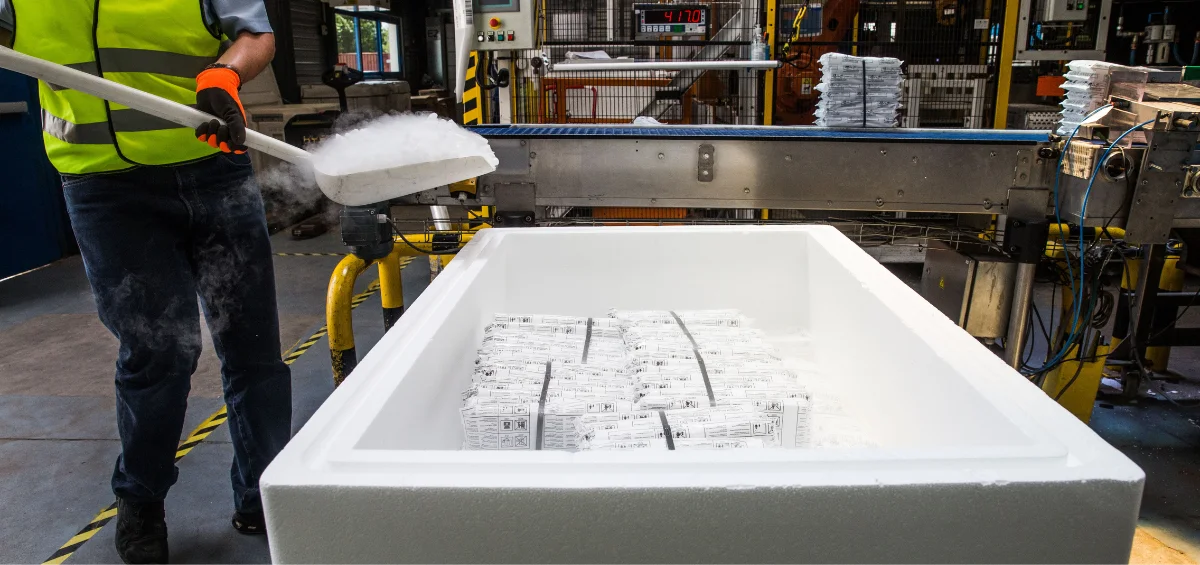
Cheese, desserts, solid CO2, live fish, medicines, beauty products… The delivery of temperature-sensitive products concerns many sectors of activity. Each sector has its own specific requirements when it comes to temperature-controlled transport. Here’s how our solutions meet your needs.
Agri-food: preserving the cold chain and best-before date
- Maintain regulated temperatures (-20°C for ice cream, +4°C for fresh produce)
- Responding to CSD constraints
- Custom food packaging (meat packagingfresh fish, cheese, pastries, ice cream, fruit and vegetables)
Pharmaceuticals and healthcare: securing heat-sensitive products
- Strict compliance with ATP regulations and health standards
- Customized pharmaceutical packaging for vaccines, medicines, biological samples
- Limit heat heat loss and ensure traceability
Cosmetics and chemistry: protecting sensitive formulas
- Guaranteeing the stability of cosmetic and chemical active ingredients
- Protect the texture, color and efficacy of products
- Use innovative, recyclable materials suitable for international transport
Logistics and distribution: optimizing reverse logistics
- Space-saving folding boxes and lightweight lightweight plastic pallets
- Vacuum return optimization
- Sustainable, reusable solutions to reduce plastic’s carbon footprint
The logistical challenges of protecting your sensitive products
Do you transport temperature-sensitive goods? Then you’re subject to the regulations of the ATP, the Agreement on the Transport of Perishable Foodstuffs under Controlled Temperature.
The first obligation concerns transport equipment which, according to the ATP, must be be equipped with an individual cold production system. This is referred to as class A for refrigerated vehicles capable of maintaining a temperature between +12 and 0°C, and class C for those able to maintain temperatures between +12 and -20°C. The isothermal vehicles are designed to limit heat exchange between the inside and outside of the body.
All temperature-controlled transport equipment must carry an ATP certificate of conformity. A blue marking, visible on the front and sides of the vehicle, indicates the cold production technique, the level of insulation and the vehicle class.
It is possible to to only in the following cases:
- Transport < 80 km without breaking the load (without opening the doors) ;
- Tanker transport of milk and cream destined for industry over a distance of < 200 km without breaking the load;
- Transport of frozen fish products to an approved establishment for thawing on arrival over a distance of < 80 km and a journey time of < 1 hour.
Of course, the temperature to be guaranteed during transport depends on the type of product. Fresh products such as frozen vegetables need to be kept between 2 and 4°C, and ice creams at -20°C, for example. Specific hygiene and safety standards must also be taken into account.
Knauf Industries offers isothermal solutions in EPS and EPP, designed to meet the time, volume, temperature and logistical return requirements of each sector.
Which isothermal solutions does Knauf Industries offer?
Guaranteeing the transport of temperature-controlled packages is not just a question of vehicles. It’s above all a question of packaging. To ensure the quality of your fragile goods, you’ll need the right isothermal crates.
As a leader in packaging and technical plastic partsKnauf Industries is at your service to design your product solutions. Our multi-sector expertise has enabled us to develop a wide range of standard isothermal packaging, and even to offer you customized solutions. The right solution for every need! Whether for logistics, warehousing, long-distance refrigerated transport or last-mile delivery, discover the packaging that meets your logistical and regulatory requirements.
EPS solutions: Frobox®, Freshbox®, Ringbox®.
Are you looking for packaging capable of maintaining your perishable goods at low temperatures, while protecting them from knocks? Are you looking for ergonomic, durable containers that reduce the risk of RSI for your employees, while respecting your CSR commitments? Discover our isothermal solutions in expanded polystyrene (EPS), a recyclable, lightweight, high-performance material from Knauf Industries:
- Pre-qualified isothermal crates (NF S 99-700 standard) FROBOX® to maintain your temperature-sensitive products between -80°C and -20°C for over 110 hours (4 days minimum), suitable for all modes of transport;
- The RINGBOX® the large-format solution for transporting solid CO2 in pellets, sticks, wafers or blocks;
- Solutions FRESHBOX® dedicated to fragile goods that are sensitive to temperature variations, in particular exotic animals (reptiles, amphibians, fish, invertebrates) or heat-sensitive temperature-sensitive products (lactic ferments, serums, biological samples).
PPE solutions: Efood Box, Komebac® Cool, Thermokulli
A second solution for your heat-sensitive and fragile products: expanded polypropylene. expanded polypropylene (EPP). Known for its lightness, strength and thermal stability, this innovative material meets environmental challenges while providing effective protection for your goods. Discover our PPE products:
- The stackable Efood Box modular crate in three different sizes, with numerous customization options (compartments, lids, gel packs, branding, etc.), ideal for foodstuffs ;
- The ultra-light cooler Komebac® Cool for short short tripsavailable in three sizes: 20, 25 and 35 L, with or without handles, and customizable for multiple uses. multiple uses (biological samples, water and sludge, food and beverages…);
- The Thermokulli box designed the hotel and catering industryThe Thermokulli box, designed for the hospitality industry, offers perfect thermal stability and complies with food hygiene and safety standards.
Reuse at the heart of Knauf Industries isothermal solutions
From 2025 onwards, companies will be obliged to reduce their environmental impact. Lhe European PPWR regulation imposes strict rules on the circular economy, recyclability and management of packaging.
To help you achieve your CSR objectives, make reuse at the heart of your approach. Choose our innovative solutions, designed to last and be reused over many cycles, unlike disposable packaging. We use circular, low-carbon materials and innovative technologies to create sustainable packaging and technical parts.
We help you reduce your waste and facilitate collection and recycling with our Knauf Circular® program.
Regulations and the circular economy: the PPWR regulation
Compliance with environmental regulations is a key issue for manufacturers.
- The European regulation PPWR provides a framework for packaging and its end-of-life, with requirements for recyclability and circularity.
At Knauf Industries, our EPS and EPP solutions are part of this approach thanks to their recyclability and the Knauf Circular® program, which ensures the collection and recycling of polystyrene. recycling of expanded polystyrene.
Why choose EPS and EPP for your isothermal containers?
Temperature control is part of Knauf Industries’ expertise. We use innovative materials such as expanded polystyrene expanded polystyrene (EPS) and expanded polypropylene (EPP), recyclable materials for their remarkable properties:
- Lightweight and robust;
- Shock and vibration absorption ;
- Thermal and acoustic insulation;
- Flexibility and design;
- Recyclability and durability ;
- Easy maintenance.
What can we learn from temperature-controlled transport?
Guaranteeing the quality and safety of heat-sensitive products is one of your legal obligations. Logisticians, transporters, manufacturers and distributors, you must respect the cold chain for all fresh foods, cosmetics, pharmaceutical products and live animals, in compliance with ATP regulations. To do this, choose isothermal crates and packaging capable of protecting your goods against temperature variations during transport and storage.
- Temperature-controlled transport involves maintaining perishable goods at low temperatureusing specially adapted isothermal equipment and packaging;
- This is the Agreement on the Transport of Perishable Foodstuffs (ATP)which is handled by Cemafroid in France, sets out the requirements for temperature-controlled transport;
- Our ranges of Knauf Industries isothermal crates comply with ATP regulations for all sectors (food, pharmaceuticals, cosmetics, etc.);
- The PPE (expanded polypropylene) and EPS (expanded polystyrene) are innovative, durable and insulating materials, perfectly suited to protecting your heat-sensitive and fragile products.
Other articles that may interest you
Link to Blog-
Read more Read more
All you need to know about Solid CO2
When it comes to dry ice, everyone thinks of the application that's closest to their heart. Today, we'd like to…
Need more information?
Contact our team of experts