Article abstract:
- Dry ice (solid CO2) is obtained by cooling and expanding carbon dioxide, sublimates at -78.5°C without passing through the liquid state and leaves no residue.
- A powerful, non-abrasive, odorless, non-flammable and non-conductive refrigerant, solid CO2 is safe when handled with gloves, suitable tools and in a well-ventilated environment.
- It is used in food processing, healthcare, oenology, cryogenic cleaning, etc., and requires optimized transport in isothermal crates.
What is solid CO2?
For the record, dry ice was discovered, not invented, in 1835. It wasn’t until the early 20th century, however, that the properties of solid carbon dioxide began to be exploited. The first commercialization took place in the United States in the 1920s.
Glace carbonique, dry ice , neige carbonique or carboglace are just some of the names used to describe this little nugget, which is none other than the solid form of carbon dioxide (CO2).
From carbon dioxide gas to dry ice…
Dry ice is produced from a natural gas, carbon dioxide. This gas is cooled in its liquid form (below -78.5°C) to obtain a solid material. Under atmospheric pressure, solid CO2 is transformed directly into vapor by sublimation, without passing through a liquid phase.
Dry ice disappears when it warms up, leaving no residue. It’s a carbon-neutral and environmentally-friendly technique, since it emits only the CO2 originally used as a by-product.
Good to know: dry ice occurs naturally, without human intervention, on the planet Mars!
What are the properties of solid CO2?
Carbon dioxide in its solid state is renowned for its many characteristics:
- Refrigerant : Because it sublimates at -78°C, dry ice is a very powerful refrigerant;
- Non-toxic : if used under the right conditions ;
- Non-flammable, odorless and antibacterial;
- Clean and approved for use in the food industry: food-grade, but be careful not to ingest! ;
- Non-conductive : Can be used safely on electrical components;
- Non-abrasive : very advantageous for dry ice blasting because, unlike sandblasting, it does not damage materials;
- A natural, environmentally-friendly product: because dry ice sublimates, its transformation into gas leaves no residue.
What are the applications for solid CO2?
Carbon dioxide in its solid state has a wide range of applications, which is why it can be found in so many different sectors. In the food industry, for example, solid CO2 is used to cool dough in kneading machines, during mincing, mixing and kneading of meat, and for rapid deep-freezing of foodstuffs. It maintains the food chain and enables food to be transported at a controlled temperature. Its gaseous state prevents damage to products and packaging.
What can we learn from solid CO2?
A natural, non-toxic and non-abrasive refrigerant, solid CO2 is widely used in industry. From food preservation to events, this product can be found in a wide range of applications. Transport it safely with our isothermal solutions from Knauf Industries. We use circular, lightweight and robust materials to meet all your needs.
Frequently asked questions about solid CO2
What forms does solid CO2 come in?
Dry ice can be used in various forms:
- Dry ice: less complex to produce, but with a rapid sublimation rate and short shelf life. Visually, it resembles snow in winter;
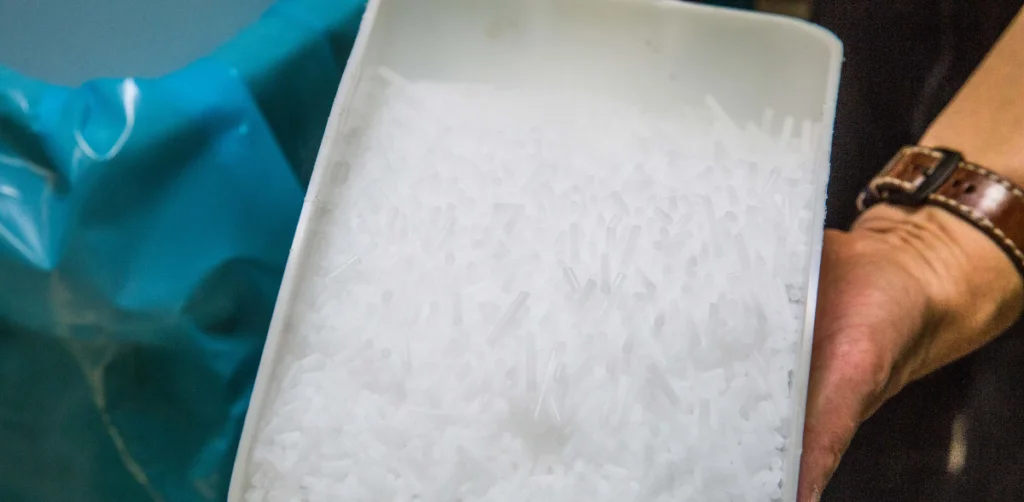
- Pellets: with a lower sublimation rate than snow. With a diameter of 1 to 3 mm, they are shaped like grains of rice;
- Sticks: often confused with pellets because of their shape, they are larger, with a diameter of between 6 and 19 mm. They have a medium sublimation rate, making them easier to store;
- Wafers: they sublimate slowly and keep longer;
- Blocks: they have the longest sublimation rate and shelf life.
Is solid CO2 a dangerous product?
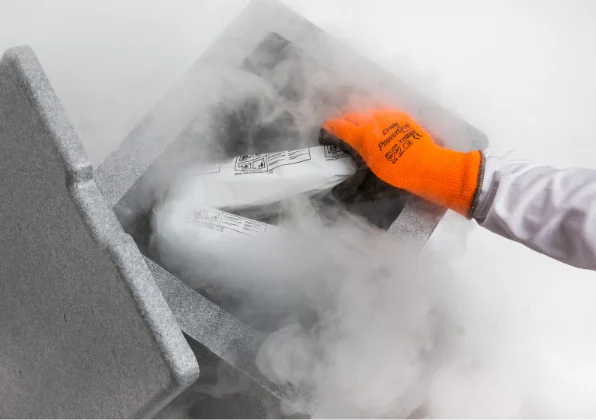
In its solid state, carbon dioxide is not a dangerous product in itself, but you do need to be very careful when handling it. Make sure you protect your eyes in case of splashes, and your hands with specially insulated gloves.
Tools such as tongs or shovels should also be used to avoid solid CO2 coming into contact with the skin. The last point to remember is to ventilate the room sufficiently, as dry ice can asphyxiate in a closed environment.
How to store solid CO2?
Safety also depends on proper storage and packaging. Care must be taken to choose a suitable container for storing and transporting solid CO2, as well as for the end user.
Dry ice sublimates: it evaporates, changing from a solid to a gas. Sublimation starts as soon as CO2 ice is produced. This evaporation can exceed 20% if the packaging is not adapted. Packaging is therefore very important in reducing this loss.
Carbon dioxide reaches its melting point at -56.6°C and its sublimation point at -78.5°C, and is stored and transported in isothermal containers with a high isothermal value.
Transport your solid CO2 with Knauf Industries isothermal solutions!
Do you need to ship pharmaceutical products or foodstuffs at very low temperatures? In an unsuitable, poorly insulated container, packaging could deteriorate, vaccines could lose their effectiveness, food could present a health risk… For logisticians, transporters and distributors of isothermal packaging, solid CO2 seems to be the obvious solution!
It’s a way of keeping your goods cool, or ensuring the success of your industrial processes. But which container should you use to transport solid CO2? Discover our French range of Frobox® and Ringbox® containers at Knauf Industries!
Frobox® and Ringbox® insulated boxes: safe and lightweight
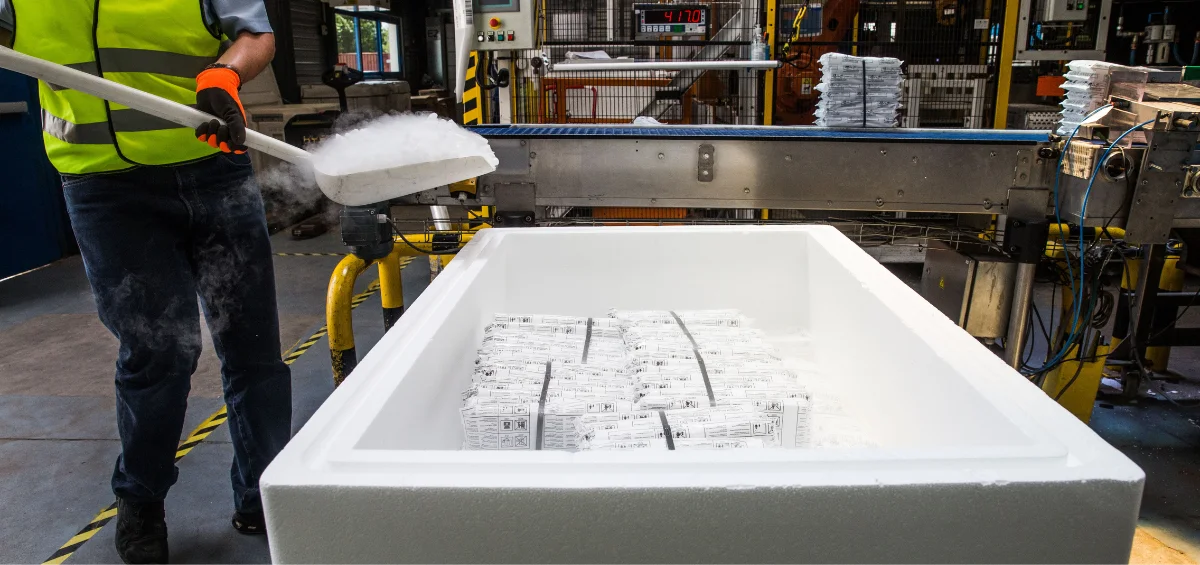
Preserve your most heat-sensitive products between -80 and -20°C in the simplest, most efficient way with Knauf Industries. Frobox® and Ringbox® packaging are specially designed for transporting solid CO2 in all its forms: pellets, sticks, wafers or blocks.
Discover our solid, lightweight and environmentally-friendly isothermal crates. Fully reusable and recyclable through the Knauf Circular® programprogram, they guarantee performance in line with the most stringent requirements in your sectors of activity (agri-food, pharmaceuticals, cosmetics, chemicals, entertainment, etc.).
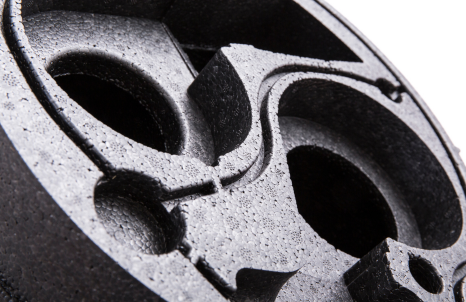
Choose Frobox® boxes for their versatility, or Ringbox® boxes for their capacity to carry heavy loads (up to 360 kg in the 300 L version). Ultra-practical and modular, you can add straps, rings, stacking stabilizers and customization elements. An ideal packaging solution for transporting solid CO2!
Why choose Knauf Industries to transport your products?
Because our materials combine strength, lightness, thermal insulation and eco-design, today we design the packaging that all sectors need. With Knauf Industries, you can store solid CO2 in the most optimal way, in practical, durable containers. For all custom requests, take advantage of our expertise in plastic injection, thermoforming and cellular molding: we bring together the best technical and human resources to satisfy your needs.
Conclusion: safe transport of solid CO2 with Knauf Industries
Securing the transport of dry ice rests on three pillars: high-performance insulated packaging, rigorous safety procedures and precise logistical dimensioning. Knauf Industries’ Frobox® and Ringbox® crates, reusable and recyclable through dedicated channels and the Knauf Circular program, combine insulation, lightness and robustness, with options for straps, rings and stacking pockets, and a load capacity of up to 360 kg in the 300 L Ringbox® version.