Advances in expanded polystyrene recycling


A framework harmonized with the PPWR regulation
The opinion ensures consistency with the future European Packaging Regulation (PPWR), which will introduce a harmonized methodology for assessing the recyclability of packaging, based on objective design criteria with a view to recycling. This European initiative, due in early 2025, is the fruit of lengthy consultation at European level, with the active participation of industry players.
Knauf Industries, alongside Elipso, remains committed to supporting this transition and continuing to promote sustainable and innovative practices, particularly in terms of integrating recycled materials.
Knauf Industries and the entire plastic packaging industry are committed to the implementation of an operational and sustainable recycling process for styrenic packaging with Creastyr , the results of which are already conclusive.
Background: The French ban went well beyond the implementation of the European Single-Use Plastics Directive (SUPD), and caused considerable uncertainty in the European market, as it was not certain that the ban would take effect.
The associations point out that packaging made from PS, EPS and XPS is fully recyclable and is effectively recycled. From an ecological point of view, such a ban didn’t make sense either, as alternative materials are generally heavier and more difficult to recycle, and therefore have a higher overall CO2 footprint.
EPS is also recognized as recyclable worldwide. The United Nations Environment Programme (UNEP) published a recent report entitled ” Plastic Pollution Science“. (Science of Plastic Pollution): ” An expert survey of members of the New Plastics Economy Global Commitment network has revealed that while many polymers are theoretically recyclable, only a handful of packaging formats have been found to be recyclable in practice and on a large scale in some countries and regions. These include PET bottles, HDPE bottles and other rigid HDPE formats (e.g. pots, trays, cups), PP bottles and flexible PE monomaterials larger than A4, the latter only in a business-to-business context (e.g. pallet packaging), and EPS for transport packaging (e.g. fish crates or protection for large items)”. In addition, the European Commission considered that the French law was “inapplicable and unenforceable” and therefore has no effect.
Read the Elipso press release here  A decisive step towards regulatory clarification
Would you like to find out more about our materials? Do you have a helmet development idea? Contact us for more information.
CREASTYR
 The professional sector of manufacturers and users is moving closer to the goal of a recycling sector for EPS packaging.
The Creastyr* project, which is the response to the regulations, continues to make progress with its partners in the development of collection and recycling schemes for household, industrial and commercial packaging.
The work initiated in 2023, such as trials at sorting centers, the launch of experimental standards at waste collection centers or takeaway/delivery systems, and the study of the recyclability of the waste collected, will continue in 2024 to promote the development and validation of the recycling sector for XPS and EPS packaging.
Various market indicator studies on EPS confirm the work we’ve done, with, for example, a recycling rate of 46% in the seafood sector (FranceAgrimer study), or a recycling rate of around 50% for industrial and commercial packaging, which accounts for 60% of EPS packaging put on the market (Creastyr/Deloitte 2023 study). These rates are in line with the target set by European Directive 2018/852: 50% by 2025 and 55% by 2030.
In its packaging sorting instructions, Citeo specifies that EPS packaging must be placed in the sorting bin (yellow bin).
The aim of the call for tenders launched and then managed by Citeo was to start recycling all PS packaging collected and sorted in France by 2023, with a commitment to recycle at least 10,000 tonnes a year. (EPS and XPS combined). This is a test for Citeo, whose aim is to massively increase the recycling of polystyrene (PS) from household packaging placed on the French market.
In addition, the Packaging and Packaging Waste Regulation (PPWR), currently being finalized, stipulates that these styrenics can be integrated into a recycling chain, with an obligation to be recyclable on an industrial scale by 2035. French law has had to adapt to this more realistic and flexible scheme, which is directly applicable in national law without any transposition measures.
The development of a recycling sector for XPS and EPS packaging will enable us to maintain and even expand our industrial facilities in France, in particular our various styrenics recycling and conversion plants, while at the same time ensuring the long-term viability of an economically highly advantageous packaging product (in addition to its functional characteristics) whose cost can be 2 to 3 times lower than that of other substitute materials.
*Creastyr is the answer to polystyrene recycling.
Elipso, the trade association representing manufacturers of plastic packaging (rigid and flexible) in France, and EUMEPS, the European association of expanded polystyrene manufacturers, are developing an effective recycling channel for EPS and XPS. This initiative meets the requirements of France’s ” Climate and Resilience ” law, which allows polystyrene-containing packaging to be recycled, provided it can be integrated into a recycling chain.
The CreaStyr project aims to organize the recycling of household, industrial and commercial packaging made from XPS and EPS. It is a major professional initiative to :
- Develop efficient collection and sorting of EPS and XPS packaging;
- Increase the recycling rate and guarantee the sustainability of the sector;
- Raising awareness and communicating about collection and recycling opportunities for EPS and XPS packaging.
KNAUF CIRCULAR
 The Knauf Group and Knauf Industries are continuing to roll out Knauf Circular® to contribute to the EPS recycling industry.
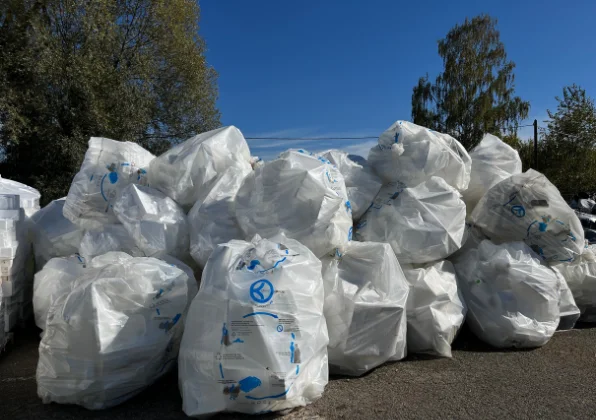
Knauf Circular® offers users of EPS products – manufacturers, seafood professionals, supermarkets, insulation installation companies, waste collection centers, etc. – an on-site collection service for their own EPS packaging or insulation waste.
This is a guarantee for all users that their EPS waste is recycled in a responsible way.
Find out more -> https://knaufcircular.fr