Faced with today’s environmental and energy challenges, European industry is undergoing a profound transformation. One of the solutions is the European Union’s Ecodesign Directive, which aims to reduce the environmental footprint of energy-related products.
On the front line of this directive, the HVAC (heating, ventilation and air conditioning) sector is directly affected by these new regulatory requirements. Manufacturers must now rethink their design processes in order to offer more efficient, more durable and more energy-efficient equipment.
But what does the Ecodesign Directive actually mean for manufacturers in the HVAC sector? And how can they comply while remaining competitive? Find out in this article.
This article in brief:
- The Ecodesign Directive imposes design requirements aimed at improving the energy and environmental efficiency of energy-related products.
- The HVAC sector is directly affected by these European regulations.
- Equipment performance is measured using indicators such as SEER.
- To comply with these requirements, manufacturers need to take action right from the design phase: sealing systems, choice of materials and energy optimization.
What is the Ecodesign Directive?
The Ecodesign Directive was introduced by the European Union in 2009 to establish a regulatory framework for improving the energy and environmental performance of products and equipment. It is part of a wider plan to reduce the energy consumption and environmental impact of equipment sold on the European market.
According to European estimates, up to 80% of a product’s environmental footprint is defined during its development. In view of this indicator, the directive obliges manufacturers to rethink their design processes in order to create products that are more durable, easier to repair and maintain, recyclable at end-of-life, and more energy and resource efficient.
What does it mean for professionals?
For companies in the HVAC sector, the Ecodesign Directive means that design, manufacturing and performance evaluation methods need to evolve. From now on, manufacturers must integrate several parameters from the outset:
- System energy efficiency ;
- Component durability;
- Ease of maintenance;
- The recyclability of materials;
- And reducing the carbon footprint over the entire life cycle.
This transformation concerns equipment manufacturers, system designers and the entire supply chain. In plain English, this means that the technical choices made at the design stage, in terms of both product architecture and materials used, become decisive factors in guaranteeing compliance with European standards.
Products and systems covered by the Ecodesign Directive
The Ecodesign Directive applies to a broad category known as “energy-related products”. This refers to any equipment that has an impact on energy consumption during use. This definition also includes components intended for integration into these products.
The main categories concerned include :
- Household appliances and electronics (refrigerators, lamps, etc.);
- Technical equipment such as electric motors;
- Materials and systems used in buildings for energy management.
In this context, HVAC equipment is obviously affected, as it is directly linked to the energy consumption of buildings. As a result, their design must meet increasingly stringent performance criteria.
This directive builds on other European regulations, such as the ErP directive and the energy labeling regulation, which aim to provide users with clear information on equipment performance.
Measurable results with the SEER index
To measure the energy efficiency of air-conditioning and cooling systems, European regulations use a number of indicators, including the SEER (Seasonal Energy Efficiency Ratio).
This index evaluates the energy performance of a piece of equipment over the period of use. It corresponds to the ratio between the energy produced and the electrical energy consumed.
Unlike some of the more ad hoc measurements, SEER takes into account a number of actual operating parameters, including reference climate data (based on readings and observations), the efficiency of the equipment in operation, and energy consumption even when certain components, such as the compressor, are switched off.
This indicator thus provides a more representative assessment of the actual performance of HVAC systems.
How can manufacturers comply with the Ecodesign Directive?
To meet the requirements of the Ecodesign Directive, manufacturers need to take action right from the early stages of equipment design. Several technical levers can be used to improve the energy efficiency and durability of systems.
Minimizing air leakage
The tightness of HVAC systems is one of the main factors in their energy performance. Air leakage leads to reduced efficiency and higher energy consumption to compensate for losses.
When designing, it is therefore essential to reduce leakage as much as possible. This can be achieved by :
- The integration of technical components perfectly adapted to system constraints;
- Optimizing interfaces between parts;
- The use of materials with excellent thermal insulation properties.
Custom-designed technical components can improve the overall airtightness of the system and limit energy loss.
The use of sustainable materials
Compliance with the Ecodesign Directive also depends on the choice of materials used in equipment. Contrary to what you might think at first glance, sustainability isn’t just about replacing one material with another. Above all, it’s about opting for solutions capable of improving energy performance while reducing environmental impact.
Technical plastic foams offer several advantages in this field:
- Excellent thermal insulation, limiting energy loss;
- Low weight reduces environmental impact and transport emissions;
- High durability and mechanical strength;
- Recycling or reuse possibilities at end-of-life.
The solution proposed by Knauf Industries: the use of EPP components
In this ever-changing regulatory context, the integration of appropriate technical components is a strategic lever for manufacturers in the HVAC sector.
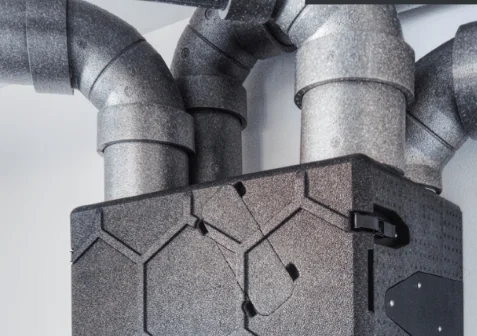
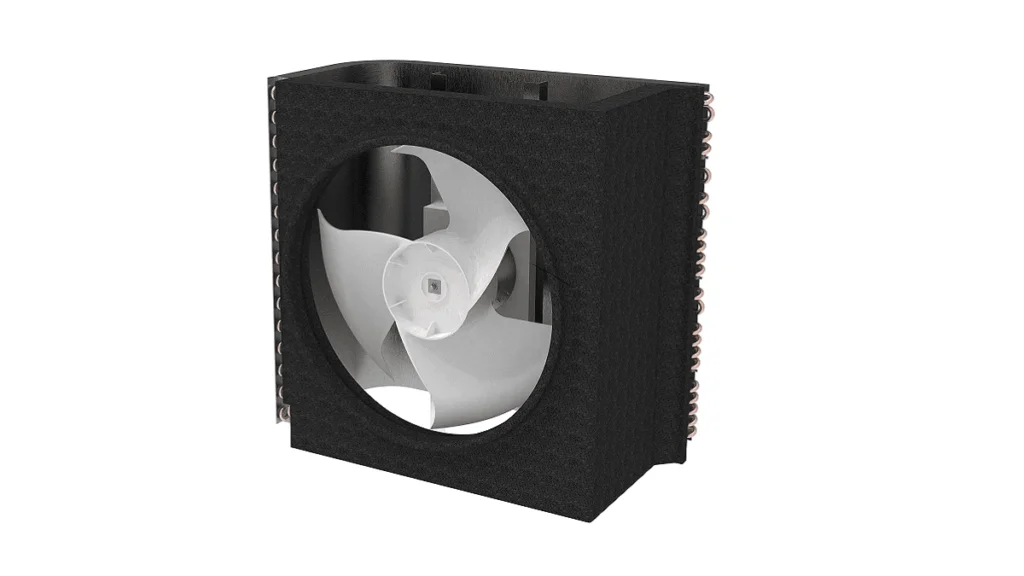
In response to these challenges, Knauf Industries has developed technical parts in expanded polypropylene (EPP), specially designed to meet performance, durability and energy efficiency requirements.
Thanks to its unique properties, EPP is a particularly suitable solution for HVAC systems, offering excellent thermal insulation, light weight, high mechanical strength, high shock and vibration absorption and end-of-life recyclability.
Our teams support manufacturers throughout the development process, from the design phase through to industrialization. Our design office and prototyping centers enable us to design customized technical components, optimized to improve the energy performance of equipment.
In a sector where regulatory requirements and market expectations are changing rapidly, EPP components are a concrete solution for reconciling compliance, performance and competitiveness.
Although the Ecodesign Directive implies major changes for HVAC professionals, it also aims to achieve more rational consumption, and therefore healthier for our planet. To comply, manufacturers need to rethink their design processes and adopt more sustainable materials such as EPP.