Understanding the challenges of carbon assessment for manufacturers
The greenhouse gas emissions balance (BEGES), also known as the “carbon balance”, first appeared in France in 2004, thanks to a tool developed by Ademe in collaboration with Jean-Marc Jancovici. However, it wasn’t until 2012, with the Grenelle II law, that the GHG balance became a legal obligation for certain companies and local authorities.
This law requires companies with more than 500 employees (within the same legal entity) and local authorities with more than 50,000 inhabitants to produce a GHG report every four years. The obligation applies solely to scopes 1 and 2, i.e. direct greenhouse gas emissions and indirect energy-related emissions.
Since 2023, legislation has evolved to include scope 3, which often represents over 60% of an organization’s total emissions. This extension makes this tool even more essential to the ecological transition. Indeed, the carbon neutrality targets set by Europe and other countries around the world can only be achieved with a sharp reduction in GHG emissions. Emissions accounting methods such as the GHG balance sheet therefore play a key role in enabling companies and governments to identify the most significant emissions items on which to take action.
Precise monitoring of GHG data with the carbon balance sheet
The carbon footprint is intended to assess the quantity of greenhouse gases produced by human activity in private and public companies. This calculation method covers all direct and indirect GHG emissions. It therefore concerns all the activities of organizations, including suppliers, service providers, transporters, etc., that contribute to their smooth running. More precisely, we talk about scope classification (described in the GHG Protocol international) :
- Scope 1: direct GHG emissions from fixed or mobile installations controlled by the company;
- Scope 2: indirect emissions associated with the production of electricity, heat or steam imported for the organization’s activities;
- Scope 3: indirect emissions, in particular from purchasing.
Because it often represents over 60% of a company’s GHG emissions, scope 3 should not be overlooked! To ignore it when calculating your carbon footprint would be to grossly underestimate your organization’s environmental impact. That’s why it’s essential to collect GHG data and assess stakeholders.
In parallel with its sustainable actions, Knauf Industries measures the GHG emissions of its activity through scopes 1, 2 and 3 of the GHG Protocol, enabling us to constantly adapt to environmental challenges. Our goal: zero net emissions by 2045. In this way, we are following the Paris Agreement’s trajectory of carbon neutrality by 2050.
A changing regulatory environment
To combat climate change, laws are evolving. Between the Paris Agreement, the Climate Act and the Green Pact for Europe, companies everywhere are seeking to reconsider their design, manufacturing, sales and waste management practices. Reducing carbon footprints means combining ecology and economy in a cleaner world.
Energy efficiency, recycled products, transport policy… For more efficient processes and a better reputation with customers, it’s in your interest to implement new actions in favor of the environment.
Moreover, from 2025 onwards, according to the Corporate Sustainability Reporting Directive (CSRD), large listed companies must include sustainability information in their management reports, such as carbon footprints. But that’s not all: other regulations may affect you and your suppliers. L e PPWR regulation controls packaging and packaging waste…
Knauf Industries, for its part, is multiplying its sustainable actions with its EPS and XPS recycling project. Creastyrand the Buddie-Pack program launched in 2022 by the European Union, which aims to develop sustainable plastic packaging in the food and cosmetics sectors.
Why is a corporate carbon footprint a must?
If mandatory
- every 4 years for many private companies
- and every 3 years for public establishments,
The GHG balance is not simply a regulatory constraint. This calculation method, which meets both current legislation and consumer expectations, is capable of boosting your competitiveness in an ever-changing market. Anticipating environmental challenges means contributing to the collective effort by enhancing your image in the long term.
Calculate your carbon footprint to assess your opportunities and risks in terms of sustainability. This first step will enable you to establish your CSR policy and action plan for the coming years. Find out more about Ademe’s GHG assessment methodsLearn how to anticipate ESG issues and communicate transparently with your customers.
Choose more sustainable materials to reduce GHG emissions
Energy audit, supplier evaluation, transport reduction… Among the most effective actions to take as part of your CSR strategy is the choice of materials. Between sourcing and recyclability, your customers will be asking questions about the composition of products and their packaging.
- Are they eco-designed?
- Are they energy-intensive to manufacture?
- Can they be reused or recycled?
Focus on quality materials to reduce your carbon footprint in 2025.
The importance of recyclability and the integration of recycled materials
What could be better for the environment than a product made from recycled and recyclable materials? In this way, you reduce the quantity of raw materials used in manufacturing, and give new life to your waste. According to Ademe, for example, the production of recycled HDPE saves 90% of carbon emissions compared to the use of new raw materials!
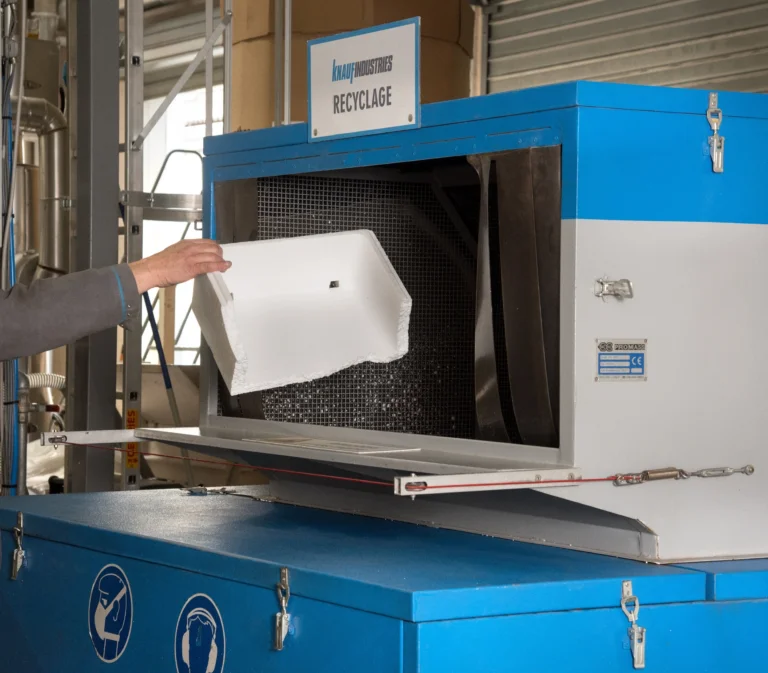
The issue of recyclability is an integral part of Knauf Industries’ CSR approach. Rather than sending our EPS and EPP products to landfill or incineration, we collect them from our customers for reuse. To reduce our Scope 1, 2 and 3 GHG emissions, we promote recycling through our Knauf Circular® all over France.
Focus on Knauf Industries’ materials innovations
Our Knauf R&D and Innovation seeks to reduce its carbon footprint without compromising product performance. We work with professionals in all sectors to optimize resources and ensure product recyclability. This is how we came up with alternative raw materials such as RELOOPS®, CELOOPS® and NEOPS®, as well as sustainable packaging in PP and PET for the food industry.
Discover all our Knauf Industries eco-design innovations!
Implementing a concrete decarbonization strategy
The decarbonization solutions deployed by companies and local authorities must meet the European objectives of carbon neutrality by 2050 and a 55% reduction in greenhouse gases by 2030. To do this, carry out a GHG assessment and set targets for reducing your carbon footprint.
With Knauf Industries, you benefit from a support service for your decarbonization projects (carbon impact calculations, eco-design through digital simulation, etc.).
Measure, trace, improve: traceability at the heart of strategy
Every corporate carbon footprint begins with data collection. All the emissions generated by your activity, both internally and externally, must be converted into tons of CO2 equivalent. This detailed analysis will enable you to identify the areas that generate the most greenhouse gases (procurement, production, transport, waste management, etc.), so that you can take the right action and make informed changes to your practices. Traceability tools are the basis for reducing your company’s carbon footprint.
Reduce your carbon footprint with eco-design
Eco-designing a product means reducing its environmental impact throughout its life cycle. This means thinking not only about the materials used, but also about how they can be used and reused. We need to be able to create a product that meets strict specifications, is both high-performance and complies with current regulations. The design must preserve mechanical properties while using as few resources as possible (electricity, water, material, etc.), and allow for reuse or recyclability.
Working with responsible suppliers
As defined by Scope 3 of the GHG Protocol, indirect GHG emissions must be taken into account in your company’s carbon footprint. To do this, you need to choose the right partners. Set up a questionnaire to evaluate your suppliers, not only in terms of price and lead time, but also sustainability. You can’t reduce your carbon footprint and claim to be eco-responsible if your suppliers don’t integrate CSR objectives into their strategy. In the interests of transparency and trust, Knauf Industries communicates its CSR results (Ecovadis, CDP, SAQ or IntegrityNext) to its partners.
Use case: how different sectors are reducing their carbon footprint
Knauf Industries supports manufacturers in their strategy of ecological transition with innovative materials and sustainable technologies. Our R&D teams study each project to optimize the energy efficiency of your products and reduce their carbon footprint. Here are a few examples.
Furniture
To limit CO2 emissions, Profim, Poland’s leading furniture manufacturer, has teamed up with Knauf Industries to combine aesthetics, quality and sustainability. In its new eco-responsible design, it has abandoned traditional plywood for recycled expanded polypropylene (RPPE), a material containing recycled material, 100% recyclable, with exceptional physical properties. The result: lightweight, durable and economical furniture that has cut GHG emissions by 40%!
Logistics
Reduce your carbon footprint with lightweight products like our KOMEBAC® bins. Our reusable packaging combines lightness and sturdiness for all your logistics operations. Save time and fuel costs. Solutions that require less material with just as much strength take up less space. So you eliminate superfluous packaging during transport!
Food industry
Waste management plays an important role in a CSR approach. Align yourself with the European Packaging Regulation (PPWR) and the AGEC law on the re-use of containers with food packaging designed by Knauf Industries. We are developing lighter, single-material, recyclable products to limit environmental impact.
Building a low-carbon industrial future, starting now
To meet new environmental challenges and boost their competitiveness, many companies start by calculating their carbon footprint. This initial GHG assessment then supports them in their overall ecological transition… and helps them find sustainable, responsible partners.
In order to achieve zero net emissions by 2045, Knauf Industries’ teams are deploying a roadmap based on three strategic pillars:
- Reducing our environmental footprint;
- Safe and attractive working conditions;
- Strong relationships with stakeholders
We involve all our stakeholders in our carbon footprint reduction objectives, throughout the entire life cycle of our products. From manufacturing to recycling, we look to the circular economy of polystyrene and innovative alternative materials. Call on a professional committed to a CSR strategy since 2020, and work with us to develop sustainable solutions.