This article in brief
- Professional establishments generate major volumes of non-hazardous waste: nearly 15 million tonnes for manufacturing industry (establishments with 10 or more employees) and over 11 million tonnes for the tertiary sector (establishments with 20 or more employees) in 2022. (Insee data published in January 2025)
- In 2024, the French plastics collection sector (all types) collected 1,024,000 tonnes and recycled the same amount (2024 data from FEDERREC)
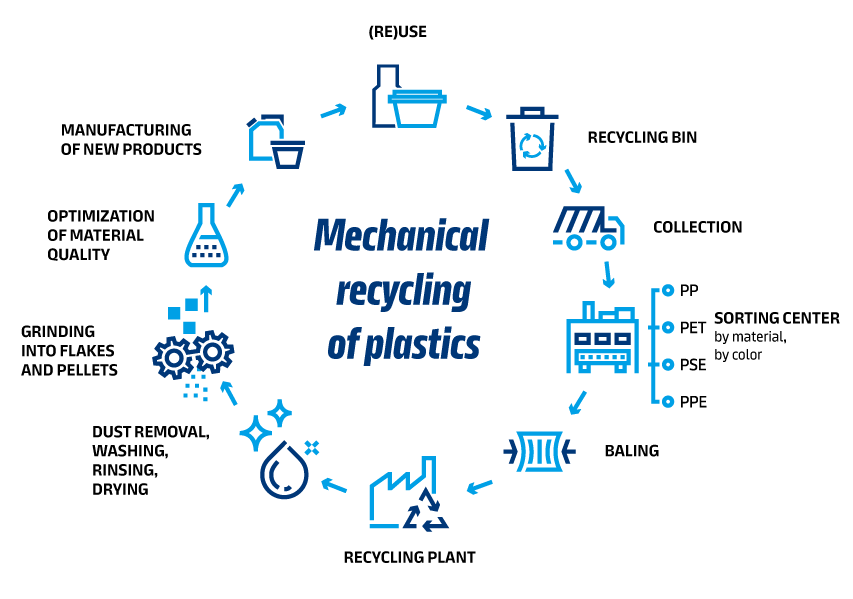
- In particular, this recovery involves the mechanical recycling of plastics, which consists in crushing used plastics and then regenerating them to give them a second life, in a re-use loop.
What is mechanical plastics recycling?
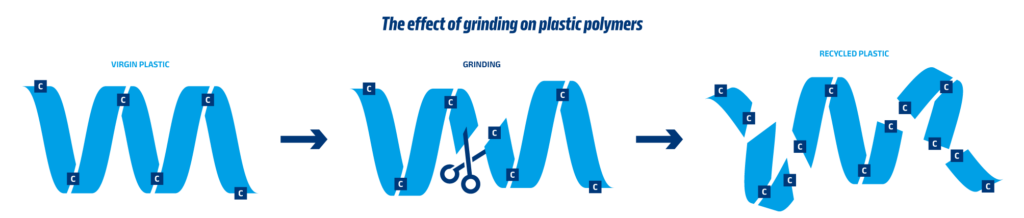
Mechanical recycling is a material recovery process plastic waste is recovered, prepared (sorted, crushed, washed) and then regenerated regenerated into a secondary raw material. During this recycling phase, the polymers are not chemically decomposed, but simply remelted and reshaped. It should be noted that the grinding and processing stages can reduce the length of polymer chains, thereby altering mechanical properties.
For professionals, the stakes are twofold, enabling them to securing flows (production scraps, offcuts, returns, packaging waste, etc.), as well as enabling them to adopt a more virtuous approach by using recycled and recyclable resources.
The 5 key stages in the mechanical recycling process
1) Collect and secure the flow
For professionals and manufacturers, the performance of mechanical plastics recycling begins with the collection. The key is to limit undesirable materials and traceability (origin, uses, additives, potential food contact, etc.). This is also where the future quality of the recyclate depends.
2) Sorting by optical and flotation separation
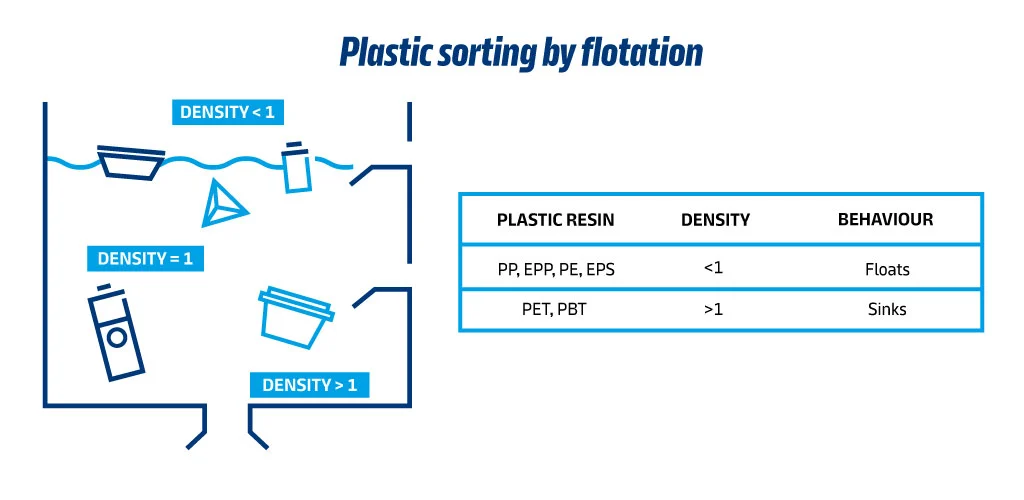
The industrial sorting of plastics is carried out in two stages. The first phase takes place in sorting centers, where waste is first separated according to shape and size. Very small products are collected much less. They are then sorted into broad material categories using metal detectors and optical sorters. For plastics, a second flotation sorting phase is carried out at the recycler’s premises, to check the isolation of the various polymers (PP, PE, PET, PS, etc.).
Mistakes can be costly, as a fraction of polymer introduced into a process can degrade properties and close off markets.
3) Grind to the right size
Mechanical plastics recycling comes into its own at this stage. We transform parts, films or products into flakes into flakes a few millimeters in size. Grinding facilitates the subsequent washing stage and stabilizes the extrusion process.
4) Wash and purify
Glues, inks, dust… all these materials in contact with plastics can degrade them. A appropriate washingwith detergents, to remove residual materials and guarantee the guarantee the consistency of flakes and their suitability for technical applications.
5) Regenerate
Finally, the material is filtered, meltedthen granulated. This is where repeatability comes into play, with filtration, degassing, stabilization and compounding. Compounding allows the incorporation of stabilizers and various additives to maintain or improve the mechanical performance and durability of the recycled material. This entire process enables the recycling of plastic waste into new polymers that can be used by industry.
What types of plastic are mechanically recyclable?
Mechanical recycling mainly concerns thermoplasticsas they can be remelted and reshaped. In professional flows, we frequently find :
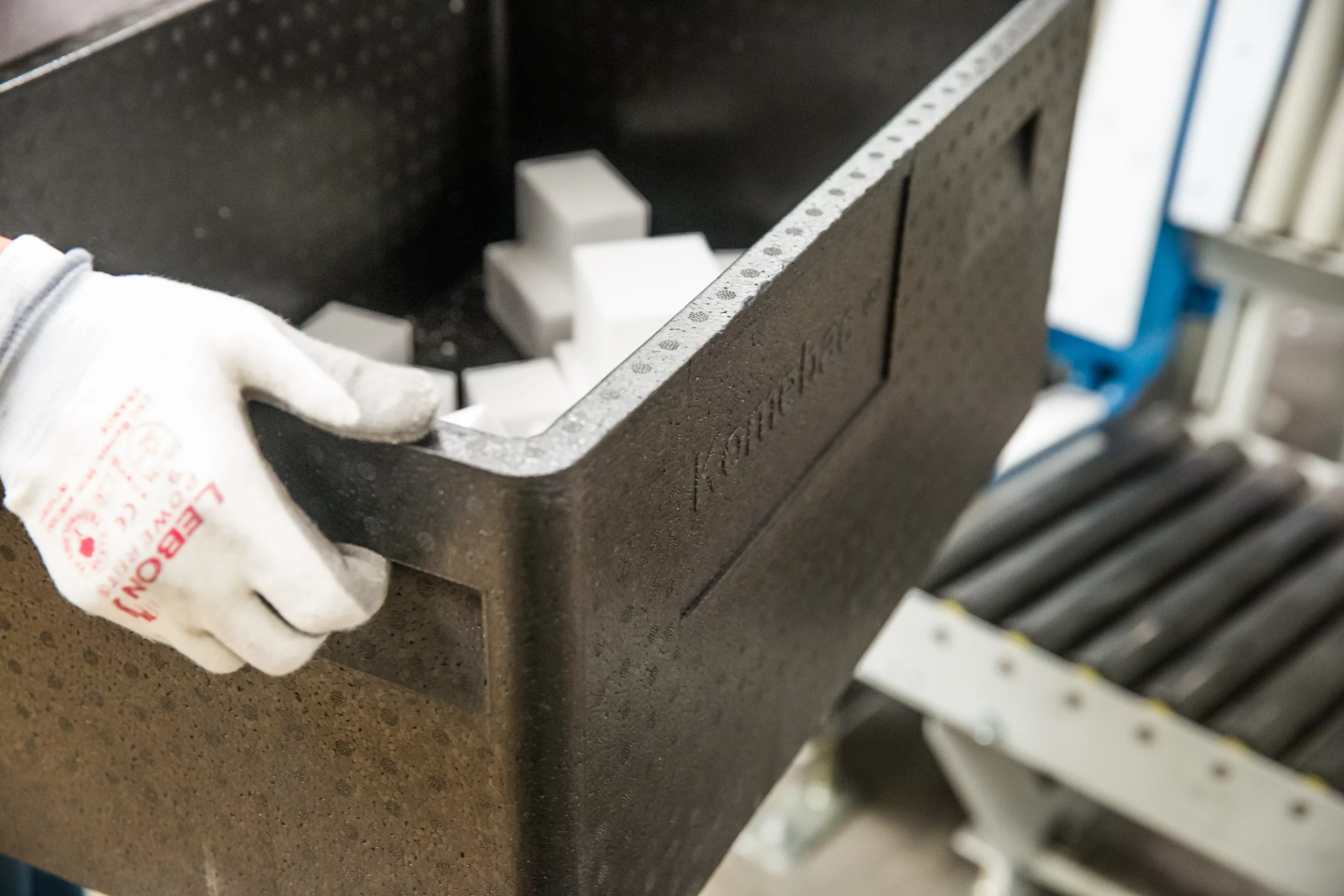
- EPS (expanded polystyrene) for wedges, packaging protection, isothermal crates…
- PP and PE (rigid and film) Products: logistics, containers, crates, extrusion offcuts…
- PET PET: some packaging, but also industrial applications depending on the sector.
- PS Specific uses, with greater quality and market constraints.
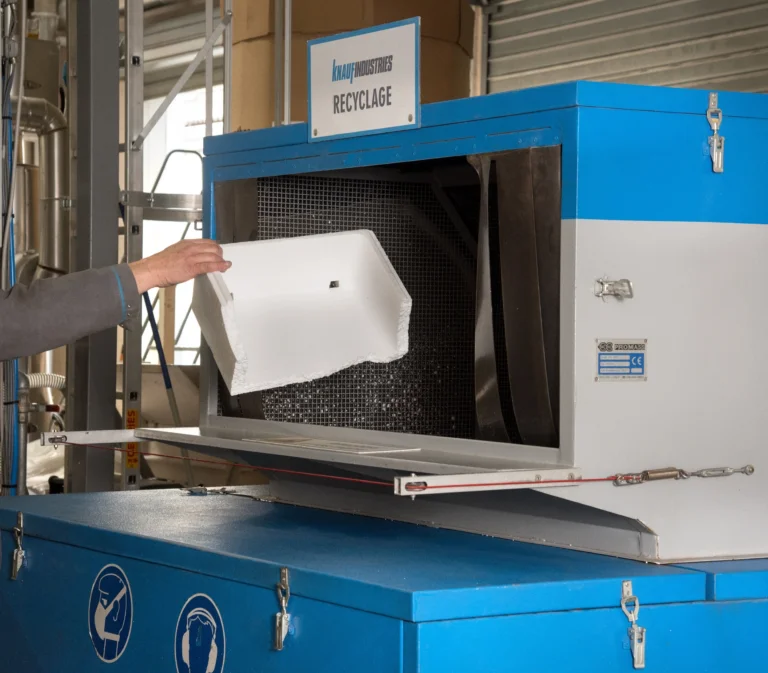
At Knauf Industries, as part of the reuse of our production offcuts and through our Knauf Circular service, we use compactors for both EPS and PP, and also have a and also have a compactor for PET.
But beyond pure material, mechanical recyclability depends above all on the purity of the flux and the simplicity of the part.. Thus, a single-material part with no multi-layers will inevitably be easier to recycle than a product made with accumulations of different polymers.
Mechanical recycling: good for the planet…
As you can imagine, mechanical recycling has a clear environmental benefit: that of reducing the energy required to produce the material. Producing virgin resin involves extracting fossil resources (oil or gas), transporting them and then using energy-intensive polymerization processes. Mechanical recycling, on the other hand, is based on existing existing material and mainly involves sorting, washing and extrusion operations..
Thus, substituting one tonne of virgin resin with one tonne of recycled material makes it possible to avoids the extraction of fossil resources and limit the energy consumption associated with petrochemical production (and, by extension, greenhouse gas emissions).
Beyond the energy question, mechanical recycling is a central tool of the circular economy. It enables waste to be transformed into a resource and material loops to be organized.
The closed-loop principle consists of reintegrating the recycled material into the same or an equivalent application. This is the case, for example, with polyolefin packaging (PP, PE) or PET bottles, which can be regenerated and then reused to manufacture new packaging or technical containers.
… but has its limits
The mechanical recycling of plastics is a concrete opportunity to limit carbon footprints, but it remains conditioned by a physical reality: the material recycled depends entirely on the quality of the original deposit.
Unlike a virgin resin, whose characteristics are perfectly controlled when it leaves the polymerization process, a recyclate comes from a flow that has already been through life, and has therefore been transformed, handled and sometimes exposed to heat, UV rays, mechanical stress or contaminants.
The first limitation is therefore linked to the very principle of recycling: the variability. Polymer blends, the presence of heterogeneous additives, pigments, glues and organic residues all have a direct influence on the final quality of the regenerated pellet. directly influence the final quality of the regenerated granulate. Even with high-performance sorting technologies and advanced washing lines, obtaining perfect purity remains a complex task when the initial flow is not strictly mono-material and homogeneous.
We also have to deal with the inevitable phenomenon of progressive degradation of polymer chains. Each processing cycle (melting, extrusion, injection) leads to a slight reduction in mechanical properties or impact resistance. This is known as downcycling when the recycled material finds outlets that are less demanding than its initial application.
Finally, the performance of mechanical plastics recycling is severely challenged by the complex design complex design of certain products on the market. Multi-material assemblies, multi-layer packaging or parts incorporating metal inserts and glued elements all complicate recyclability.
Component separation becomes costly, if not technically unrealistic on a large scale. This means that recycling performance depends upstream on eco-design choices. With this in mind, Knauf Industries favors as far as possible eco-design processes and the single-material plastic parts. However, in order to maintain mechanical performance in line with usage requirements, it is often essential to use mixtures of virgin and recycled materials.
Mechanical recycling of plastics is a concrete and already active pillar in the drive towards a more circular economy. It offers professionals a solution for reducing the carbon footprint of their production, securing part of their supplies and meeting growing regulatory requirements. But it’s not the only way to recycle plastics, as there are many different methods for dealing with the particularities of each polymer, which we’ll be presenting in more detail over the coming weeks.