Thermal resistance of expanded polystyrene (EPS)

Used in all sectors (industry, construction, automotive, health, cosmetics, agri-food...), expanded polystyrene (EPS) owes its success to its thermal resistance. It enhances the performance of all walls in buildings, roads, packaging and technical equipment. Find out more about this choice material from Knauf Industries, experts in custom EPS insulation and packaging for businesses.
Blog Post Featured Image

Article abstract:

  • Expanded polystyrene (EPS) is 98% air, making it ideal for insulation and technical packaging.
  • Its insulating power is measured by λ (0.030 to 0.038 W/(m.K)) and the resistance R = e/λ. For example, a 100 mm panel with λ = 0.032 offers R = 3.13 m²K/W to limit heat loss and improve comfort.
  • Lightweight and robust, EPS simplifies installation, withstands heavy loads and is recyclable through dedicated channels and the Knauf Circular® program.

What is expanded polystyrene?

Polystyrene is an insulating material of organic origin. It is obtained by polymerizing styrene. Polystyrene beads become expandable in the presence of an expanding agent, pentane. Under the action of steam, these expandable beads swell by 50 times their original volume to form a closed‑cell bead foam structure made up of 98% air: expanded polystyrene (EPS).

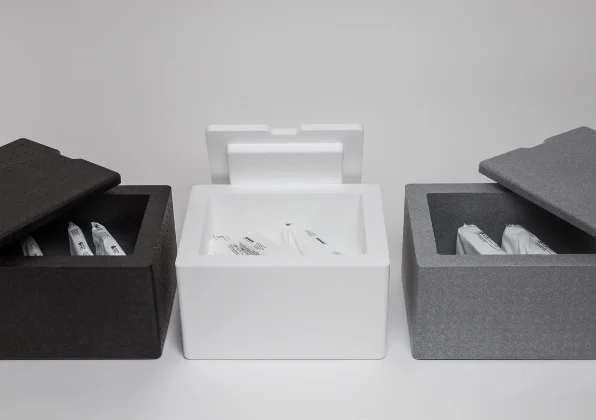
Classically white, expanded polystyrene can be mixed with graphite during manufacture, which gives it a gray tint. Grey polystyrene, less commonly used than white, offers improved thermal conductivity. It can be recommended for the packaging of specific products.

Find EPS solutions for your thermal insulation needs at Knauf Industries! To limit heat loss and insulate against noise, we offer manufacturers in all sectors a complete range of EPS packaging and technical parts. Houses and apartments, swimming pools, industrial buildings, technical equipment, green roof terraces, roads and green spaces… Reduce your energy losses and improve your customers’ acoustic comfort, in compliance with current regulations.

How is the insulating capacity of expanded polystyrene calculated?

The insulating capacity of a material is defined by its lambda thermal conductivity coefficient (λ). It represents the amount of heat that a one-meter-thick material lets through a one-square-meter surface for one second, when its two faces differ by one degree. Thermal resistance is expressed in watts per meter-Kelvin (W/(m.K)). The lower λ, the better the material’s insulating capacity. Thus, with a λ coefficient of between 0.030 and 0.038 W/(m.K), polystyrene is a particularly effective thermal insulator.

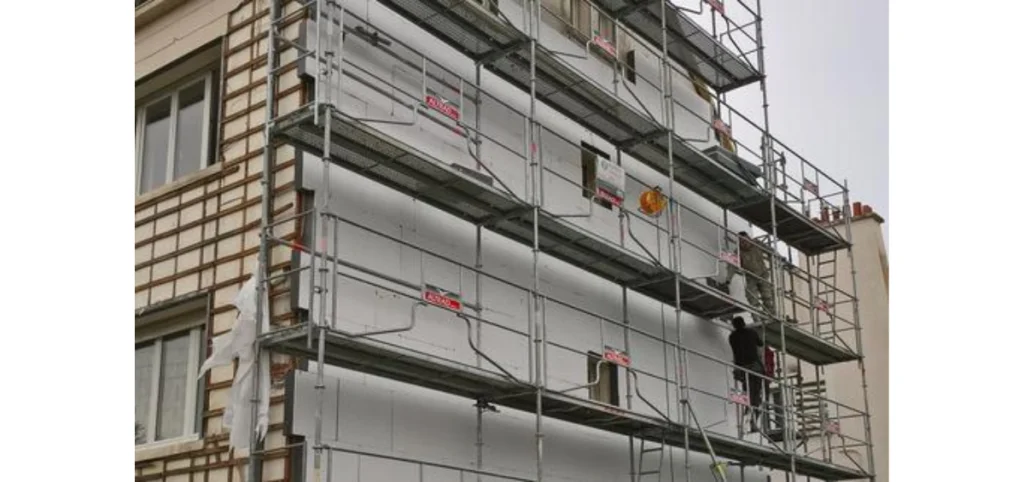
Immeuble avec échafaudage et pose d'isolation

Need more information?

Find out more about our EPS solutions for protecting your packaging and technical parts.

How do you compare the insulating performance of different materials?

To compare the thermal performance of different materials, it’s useful to know their thermal resistance: the greater the resistance, the more insulating the material. Thermal resistance, expressed in square meters Kelvin per watt, depends on the material’s thermal conductivity (λ) and thickness (e).

Thermal resistance is calculated using the following formula: R = e / λ.

An example?

Let’s take a 100 mm thick insulating panel with a thermal conductivity λ of 0.032 W/m.K. The thermal resistance R of these panels would then be: 0.1 / 0.032 = 3.13 m²K/W.

What are the advantages of expanded polystyrene?

The great advantage of expanded polystyrene is its versatility. Quite simply, it ticks all the boxes: thermal insulation, mechanical strength, practicality, customization, environmental impact… In the end, there are very few shortcomings to be found. Here’s what EPS can do for manufacturers in all sectors today.

Outstanding thermal resistance

When it comes to thermal resistance, the performance of EPS insulation is beyond question. Since this material is 98% air, an element with very low thermal conductivity, expanded polystyrene is one of the best insulators on the market. It provides efficient insulation, limiting energy loss, improving thermal comfort and reducing operating costs, while complying with regulatory requirements.

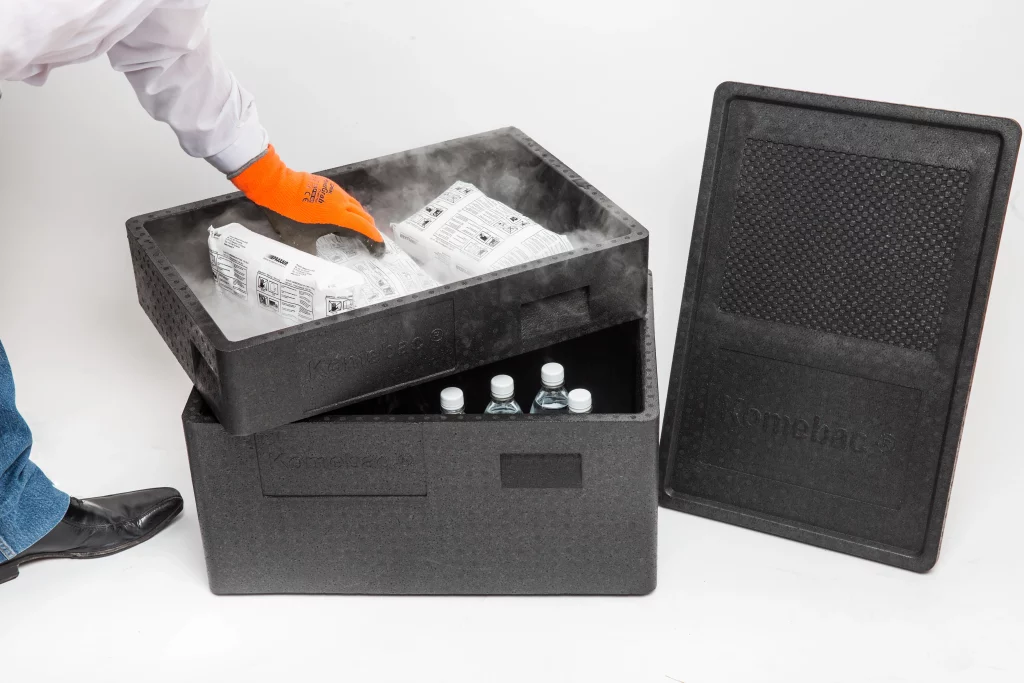
EPS is particularly effective for external thermal insulation (ETI), with good resistance to humidity, but it is also used in packaging for food and pharmaceutical products, for example.

Combining lightness and robustness

Because it’s mainly composed of air, expanded polystyrene is very light. It’s easy to cut, handle and lay on your floors, roads, roofs, etc. It’s also a way of reducing your employees’ MSD during transport (and cutting your fuel costs).

EPS also boasts outstanding compressive strength, enabling it to withstand high horizontal and vertical operating loads. It can therefore be used in building and civil engineering without any problem. An insulating material that’s both light and strong, it’s ideal for simplifying your work!

A response to thermal regulations

When we talk about thermal insulation, we’re not just talking about comfort. We’re also talking about French and European environmental regulations. Today’s industries are confronted with the challenges of climate change, which is why the choice of material is essential.

If you’re selling or renting a home, for example, energy-efficiency renovations will enable you to comply with the French RT2012 and RE2020 standards for the building sector. Swimming pool manufacturers and distributors, meanwhile, will limit heat loss using European standard NF EN 17645. To achieve good thermal resistance, they can use expanded polystyrene solutions. What’s more, it’s a recyclable material, which we collect and recycle in our Knauf Circular® program program and through dedicated channels.

KNAUF INDUSTRIES, WORLD LEADER IN EXPANDED POLYSTYRENE PARTS

Knauf Industries is the world’s leading polystyrene converter, and the French market leader for EPS molded parts. Over the past 40 years, Knauf Industries has developed expertise in the manufacture of technical parts and packaging, enabling it to serve particularly demanding industrial sectors.

In addition to the European CE mark, Knauf systems using expanded polystyrene benefit from ACERMI certification, a guarantee of quality for insulating materials. ACERMI certification allows us to analyze the material’s performance on a number of levels: thermal conductivity, mechanical resistance, reaction to fire, etc.

Thanks to the diversity of its manufacturing processes, Knauf Industries offers a wide range of technical foams (expanded polypropylene, PS-PE copolymer, etc.) with thermal resistance adapted to all your needs. If you have any questions about choosing the most suitable materials for your needs, please contact our experts.

All Neopolen recycled grades are Recyclass certified according to European standards Learn more