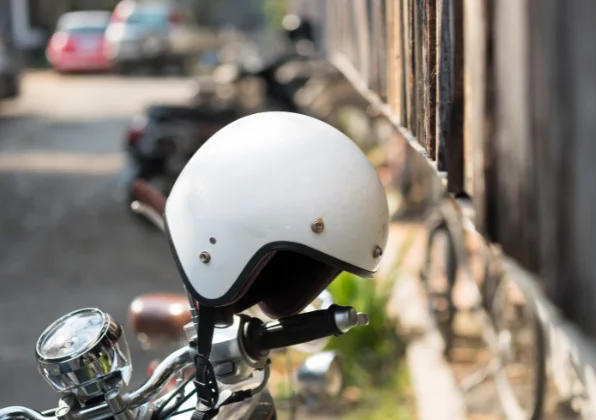
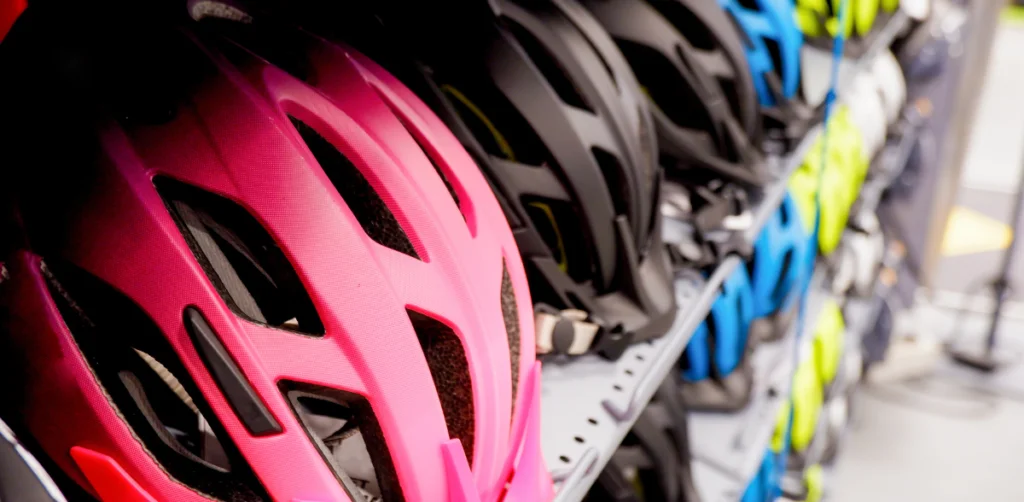
Children wear helmets when cycling
It was in 2017 that the wearing of bicycle helmets became compulsory in France for children under the age of 12, whether drivers or passengers (Decree n°2016-1800).
In young children, impacts to the head can cause more serious trauma than in adults or teenagers. According to Sécurité Routière, helmets reduce the risk of serious head injury by 70%, the risk of minor injury by 31% and the risk of facial injury by 28%.
Did you know that an adult accompanying a child without a helmet is liable to a fourth-class fine (€90)?
It’s not compulsory for adults to wear helmets, but helmets are recommended, which also sets a good example for younger riders!
In other European countries, so far only Finland has made helmets compulsory for adult cyclists throughout its territory.
Straight down with your helmet on
Although recommended on the slopes, in France helmets are only compulsory in children’s ski schools. According to a YouGov poll for HuffPost, “9 out of 10 French people are in favor of mandatory helmet use”.
In other countries, helmets are compulsory for children, as in Austria, Italy, Spain and the USA.
A Canadian study has shown that wearing a helmet reduces the risk of injury by 35%.
Climb safe with your helmet on
There is no legal requirement to wear a helmet when climbing. There is, however, a regulated framework for activities programmed and/or supervised by clubs belonging to the Fédération Française de la Montagne et de l’Escalade, notably for activities such as canyoning, via-ferrata, mountaineering and ice climbing.
One of the greatest dangers in climbing comes from above, from falling rocks.
Straddling the safety fence…
The French Sports Code does not require riders to wear a helmet (or rather a riding helmet) when riding. But beyond the legal obligation, it’s the rider’s safety that’s at stake. In riding schools and stables, it’s the rules and regulations that apply, so some establishments may require it. If they don’t, they must clearly specify the importance of wearing this type of equipment.
French Equestrian Federation (FFE) regulations stipulate that helmets must only be worn during competitions.
There are many other helmets, including those for motor sports, water sports (rafting, canoeing, kayaking, etc.), aerial sports and personal protective equipment (PPE).
How are helmets designed?
A helmet is made up of several components, 2 of which are essential:
- The outer shell: which can be made of PVC, polycarbonate, with carbon reinforcements, expanded polystyrene or expanded polypropylene.
- The inner shell: often made of expanded polystyrene or expanded polypropylene
And the helmet of tomorrow?
When innovation serves the environment, we can imagine tomorrow’s single-material helmets, which will reduce the number of components, reduce the panel of suppliers and facilitate end-of-life recycling.
One criterion to be taken into account for future developments is ease of transport, so that helmets are always within easy reach. This leads us to think about folding helmets.
Technology and connectivity also have a major role to play in tomorrow’s helmets: integrated turn signals, Bluetooth connections, voice assistants, fall detection… Connected helmets will extend the user experience.
Habits are changing, as in skiing, where the performance of equipment helps to increase speed. Helmets must adapt to these new habits.
Last but not least, research continues to find the most suitable materials for enhanced protection while maintaining optimum comfort.
What do technical foams do for you?
Closed-cell bead foams, such as expanded polystyrene or expanded polypropylene, can be used to design helmets with :
- Shock absorption: when impact occurs, the cellular foams absorb the impact energy. This greatly reduces the risk of serious injury in the event of an accident.
- Lightness : these materials are composed of very little material (2% material for expanded polystyrene and 98% air; 4% material for expanded polypropylene and 96% air). Lightness offers comfort for prolonged wear.
- High rigidity and low density: keeps the helmet sturdy while keeping the overall weight to a minimum.
- Recycled, recycling, circularity and end-of-life management.
What if the helmet of tomorrow were made entirely of expanded polystyrene or expanded polypropylene?
Would you like to find out more about our materials? Do you have a helmet development idea? Contact us for more information.